Last week, the conservative periodical “National Review” took time out from calling Donald Trump a fascist to take a swing at America’s most important ally in East Asia with an article by Josh Gelernter called, “Japan Reverts to Fascism”. The author wrote with great alarm that Shinzo Abe’s Liberal Democratic Party and the coalition it leads recently won a large enough majority in both houses of the legislature to amend the Japanese constitution, the constitution which Japan has had since the end of World War II and which has never been amended to date. He describes all of the ways that, in his mind, Japan is reverting to a fascist state which seems an odd thing for a conservative American magazine to say about a conservative government that is America’s staunchest ally in the region and easily one of our most important allies in the world. Calling someone a “fascist” is usually the trademark of the left. In fact, today, about the only definition of a fascist is anyone who the left doesn’t like. It is a bizarre and inflammatory accusation to make just at the outset. But, he made it and so must back it up. What evidence does Mr. Gelernter present to justify such an accusation?
He begins by pointing out that Prime Minister Abe and many of his compatriots belong to a nationalist group called Nippon Kaigi which portrays the Japanese as the ‘good guys’ in World War II who were simply trying to liberate East Asia from the clutches of the wicked white race only to become the victims of the overpowering force of the Allies. This is, admittedly, his strongest point as a failure to understand and recognize the mistakes of the past leaves a country vulnerable to repeating them and World War II was certainly a mistake for Japan. The Empire of Japan was destroyed by it, so obviously that wasn’t good for Japan or anyone else. However, as troubled as people in the west have every right to be about being vilified, the effort to refute the vilification of Japan is not something that should be considered troubling or at all unusual. Western countries have done immense damage to themselves by indulging in a masochistic guilt-complex and Japan would be wise to avoid a similar mistake. Also, the fact that the Japanese would have a different point of view, whether you think it right or wrong, about World War II should not be considered that outrageous.
For the sake of a largely American audience, allow me to point to some examples that will best illustrate why this is a double-standard. Most Canadians have a very different view of the War of 1812 than most Americans. Most Mexicans think they were the ‘good guys’ in the War for Texas Independence and the Mexican-American War. Although it is not the case today, for much of American history, most British people had a very different view of the American War for Independence than most people in the United States. Does this bother anyone today? Again, until relatively recently, most Americans in the south still thought they were the ‘good guys’ and the United States were the ‘bad guys’ in the Civil War. It is actually normal for countries to have different points of view about conflicts depending on which side you were on. Now, Japan has not been entirely consistent on this point, particularly concerning the other Axis powers Japan willingly joined before the war started but it is perfectly natural for any country to give their own side the benefit of the doubt compared to others. I could also point out that China and Russia also both have different opinions about World War II compared to the western Allies but no one seems to mind that very much.
However, while that first exhibit on the part of Mr. Gelernter may have some, small, bit of merit to it as something America and other western countries should be concerned about, his case goes from that rather shaky bit of ground to fall headlong into a bottomless pit of ridiculousness. He says that the people in power in Japan are still mad about the Japanese Emperor being forced to renounce his divine status, which is something that is debatable but which, in any event, is something that anyone in Japan should have every right to be upset about. He mentioned fairly early in the piece, which I reserved bringing up until now, that part of the proposed amendments to the constitution that the Japanese government is seeking were described by the LDP with the words, “several of the current constitutional provisions are based on the Western European theory of natural human rights; such provisions therefore [need] to be changed.” Mr. Gelernter takes great exception to there being anything objectionable about “Western European theory of natural human rights”. However, isn’t one of those human rights the freedom of religion? Shouldn’t the Japanese be free to practice the form of Shinto, their own native faith, however they choose? Don’t they have the freedom to believe in the divinity of their Emperor just as other people believe in the divinity of Jesus? Isn’t this one of the main points of the version of human rights he’s defending?
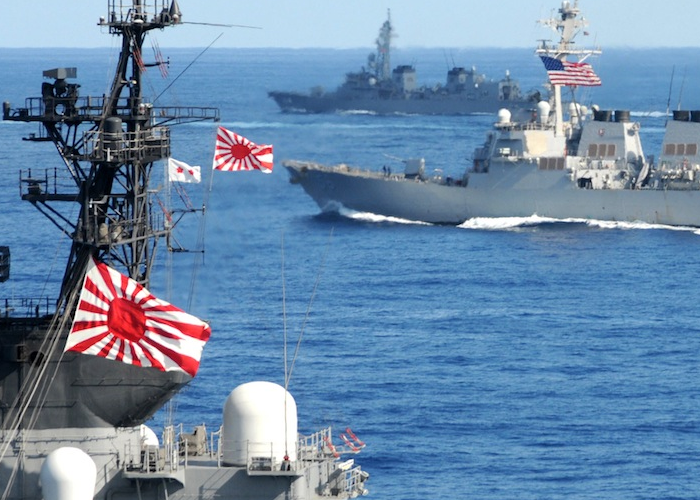
This is why I say that, by the logic of Josh Gelernter, if the Japanese are fascists, then so are you, so am I, so is almost everyone reading these lines. Does wishing to worship according to your own beliefs make you a fascist? He goes on from there to point to such things as people flying the Japanese naval ensign, aka “the Rising Sun” flag which was formerly the flag of the Imperial Japanese Navy, is currently the flag of the Japanese Maritime Self-Defense Force and so has been in use long before World War II and is still in use today. Does flying a flag of your country make you a fascist? Probably the most absurd thing he points to as evidence, however, is the Japanese national anthem. He seems to have an obsessive paranoia about this song, the lyrics of which are the oldest national anthem in the world so, again, something that was around long before World War II, long before fascism ever existed. It is a song wishing for a long reign for the Emperor which makes it about as “controversial” as the British national anthem, “God Save the Queen”. Does singing your own national anthem make you a fascist? If you think that is a silly question, why does this only seem to apply to Japan whereas in every other country, flying a historic flag or singing your national anthem is considered the most basic and inoffensive forms of patriotism and nothing sinister at all?
He also points to certain words and international rankings about the media to imply that freedom of the press is being restricted in Japan. He warns that the NHK, the state broadcasting network, is a mouthpiece for the government, implying that it spouts nothing but right-wing propaganda. Anyone can watch the NHK (it has an English-language channel) and see for themselves that this is ridiculous. If anything, the content on NHK is viewed by most Japanese on the political right as being skewed toward the left. This should not be considered surprising given that anyone with any honesty will say the same about the BBC in Britain, the CBC in Canada or the ABC in Australia. In the United States, given what is put out by the likes of CNN, MSNBC or FNC, I have a hard time taking such concerns about Japan seriously. The media itself is the biggest threat to a free press these days given how widespread, around the world, dishonesty and bias is. There is a reason why most Americans, in a country that prides itself on its free press, considers the media extremely dishonest and untrustworthy.
Finally, he also mentions the changes regarding the armed forces in Japan and the degree to which Japan has recently been strengthening the Self-Defense Forces. For an American conservative magazine to make an issue of this is appallingly ignorant. The United States has been urging Japan for decades to strengthen itself so as to be a stronger ally. A strong ally is a help whereas a weak ally is liability. That is a fact so basic that anyone should be able to grasp it. Japan is also in a very dangerous neighborhood. Russia still occupies Japanese territory, North Korea is constantly firing missiles in their direction and Communist China has been building up its military forces at an alarming rate while also making claims to Japanese territory. Any other country in the world with any sense at all would be doing everything they could to strengthen themselves in such a position. I will say again, if flying a flag, singing the national anthem and wanting a strong military is evidence of fascism, then almost every other country in the world would be considered fascist as well.
No, there is obviously a double-standard at work here and it just might have to do with those “Western European” theories about human rights Mr. Gelernter is so fond of. The nations of Western Europe and North America have, sadly, adopted a very liberal, internationalist mindset and guilt-complex that is destroying western civilization. An entire people seems bent on suicide and the people of Japan would only be showing great wisdom in wishing to take a different path. Are we holding up these same values at all anymore anyway? Freedom of religion is one Mr. Gelernter does not seem willing to extend to Japan and in the west it seems these days that some religions have more freedom than others. Freedom of speech also seems to be ever more restricted these days. Freedom of assembly doesn’t seem to be evenly applied anymore, it depends on what you are assembling for. Did anyone notice that the Bush family boycotted the recent Republican National Convention? I know, they oppose Donald Trump but it certainly paints an odd picture that a man like George W. Bush who would go to war to spread democracy would stay home and pout when the democratic process in his own party does not go the way he wanted it to.
The left, and now apparently the National Review, has become so fond of labeling anyone they disagree with a “fascist” that the term has effectively lost its sting. Taking a righteous pride in the symbols of your own country, like your flag or your anthem, to revere your monarch, to want strength and security for your nation and, yes, even to defend the honor of your forefathers should not be considered negative things and the fact that some would shows only that there is something very wrong with them, not with Japan. Of course, anyone can agree or disagree with certain points taken by the Japanese government, one can agree or disagree with their views on World War II but to make such accusations as this article does, for the reasons that it does, is simply disgusting and more alarming than anything coming from Tokyo. To love your country, to wish it to be strong and secure and to take your own side in an argument is natural and would previously have been accepted by everyone as simple common sense. If, however, that is the current measure of what it means to be a fascist, then, all I can say, is that the western democracies must owe a profound apology to the spirit of Mussolini.
Showing posts with label america. Show all posts
Saturday, July 23, 2016
Saturday, May 7, 2016
Japan and Donald Trump
One of the more interesting things about the surprising rise of Donald Trump to the rank of presumptive Republican nominee for President of the United States has been the reaction of foreign governments to his stated "America First" policy. Needless to say the most critical have been China and Mexico; the Chinese because Trump has accused them of ripping off the United States through currency manipulation and stealing American manufacturing jobs. He has openly threatened a 'trade war' with China. For Mexico it is the matter of Trump promising to build a wall along the U.S.-Mexico border and make the Mexicans pay for it through trade tariffs. However, they are not the only ones who have expressed outrage over the possibility of a Trump presidency. Western Europe has denounced Trump's immigration policies as well as his promise to make all members of the NATO alliance pay their fair share rather than depending on America to shoulder the majority of the burden for defending the continent. There have also been various reactions to Trump from East Asia after he stated that Japan and South Korea should not depend so heavily on the American military for security and that, perhaps, the U.S. forces will pull out and these countries should develop their own nuclear arsenals to deter threats from North Korea. About the only major foreign leader who has been positive about the rise of Donald Trump is Russian President Vladimir Putin.
Whether Trump will be the next President of the United States we cannot know but he has already done an important service to the country by shaking up major positions and mindsets that everyone had taken for granted and he has revealed things about the rest of the world to the American people as well as revealing to the rest of the world the fact that the American people see things very differently than they do. In regards to Japan specifically, the reactions to Mr. Trump have been very interesting. Some, like internet-celebrity Yoko Mada ("Random Yoko") have exuberantly cheered Donald Trump, whereas others, on the left and the right (as in America) have been extremely critical of his campaign and have expressed opposition to a potential Trump presidency. However, what I find most fascinating is the number of people who say the oppose Donald Trump but who reveal themselves to be in favor of most of his policies, at least as it regards Japan, they just support them for different reasons. At the end of the day though, they are on the same page!
On matters of trade, many have taken offense at Trump for saying that Japan has been "ripping off" the United States since the United States buys far more goods from Japan than Japan buys from America. He typically says this in a more complimentary way though, saying that Japanese leaders have been smarter than their American counterparts and so it is the incompetence of American officials rather than the Japanese that is to blame for any problems in this regard. Critics of Trump, however, often oppose the current trade agreements and the proposed TPP deal, just for different reasons. So, what is the problem? Likewise, on national security matters, many of the same people who criticize Trump for saying that Japan should develop its own nuclear weapons, have also objected to U.S. military bases being in Japan, have opposed nuclear warships using Japanese ports and have pointed to the alliance with the United States as the reason why Japan has so much trouble with neighbors such as China, Russia and North Korea.
This sentiment has actually been mirrored in the United States with people on the left opposing U.S. military support for Japan because they sympathize with China and believe that if America withdraws its protection from Japan, the government in Tokyo will have no choice but to give in to Chinese demands on historical disagreements and make friends with China. Likewise, they believe that if the U.S. would only withdraw its military forces from Japan, the Japanese government would have to renounce the claim to the Northern Territories and finally sign a permanent peace treaty with Russia. For the left, the U.S. military alliance with Japan is the only impediment to these conclusions as they blame it for "propping up" the right-wing groups in Japan. Similarly, the left in Japan has long been opposed to the U.S. military presence in places such as Okinawa and favored repairing relations with China while some on the right in Japan have likewise blamed their lack of a strong, traditional military and national pride on the (secret) opposition from their 'all-powerful overlords' in Washington DC. Either way, it seems both sides should be supporting Donald Trump!
At the end of the day, what everyone should remember is that Trump is a businessman and so he tends to view things dispassionately in terms of a cost/benefit analysis. The mistake many people have made is in thinking that the current state of affairs benefits the United States. Trump and his success have revealed that Americans do not and have not seen such benefit. Even on the Democrat side, the popularity of Bernie Sanders who also thinks current trade agreements are unfair and also opposes American military involvement overseas, also points to how widespread this sentiment is. So, for Japan, the situation is actually very simple. Is the U.S.-Japan alliance a cost or a benefit? Would it be better to remain friends with America or make friends with China? If a new alliance system is called for, would a country such as India be as willing and as able to defend Japan as the United States? It is up to Japan to decide, as it always has been. In the meantime, Trump may be helping Japan either way by prompting the Japanese people to take national security more seriously and increase military strength, either to be an equal partner with Trump's America or to face current threats alone or alongside countries with less military strength than the U.S.A. which would still compel Japan to become stronger or give in to the demands of her neighbors.
It will be fascinating to see how this all plays out. The status quo is being questioned in a way it never has before and that, at least, is a good thing in my view.
Whether Trump will be the next President of the United States we cannot know but he has already done an important service to the country by shaking up major positions and mindsets that everyone had taken for granted and he has revealed things about the rest of the world to the American people as well as revealing to the rest of the world the fact that the American people see things very differently than they do. In regards to Japan specifically, the reactions to Mr. Trump have been very interesting. Some, like internet-celebrity Yoko Mada ("Random Yoko") have exuberantly cheered Donald Trump, whereas others, on the left and the right (as in America) have been extremely critical of his campaign and have expressed opposition to a potential Trump presidency. However, what I find most fascinating is the number of people who say the oppose Donald Trump but who reveal themselves to be in favor of most of his policies, at least as it regards Japan, they just support them for different reasons. At the end of the day though, they are on the same page!
On matters of trade, many have taken offense at Trump for saying that Japan has been "ripping off" the United States since the United States buys far more goods from Japan than Japan buys from America. He typically says this in a more complimentary way though, saying that Japanese leaders have been smarter than their American counterparts and so it is the incompetence of American officials rather than the Japanese that is to blame for any problems in this regard. Critics of Trump, however, often oppose the current trade agreements and the proposed TPP deal, just for different reasons. So, what is the problem? Likewise, on national security matters, many of the same people who criticize Trump for saying that Japan should develop its own nuclear weapons, have also objected to U.S. military bases being in Japan, have opposed nuclear warships using Japanese ports and have pointed to the alliance with the United States as the reason why Japan has so much trouble with neighbors such as China, Russia and North Korea.
This sentiment has actually been mirrored in the United States with people on the left opposing U.S. military support for Japan because they sympathize with China and believe that if America withdraws its protection from Japan, the government in Tokyo will have no choice but to give in to Chinese demands on historical disagreements and make friends with China. Likewise, they believe that if the U.S. would only withdraw its military forces from Japan, the Japanese government would have to renounce the claim to the Northern Territories and finally sign a permanent peace treaty with Russia. For the left, the U.S. military alliance with Japan is the only impediment to these conclusions as they blame it for "propping up" the right-wing groups in Japan. Similarly, the left in Japan has long been opposed to the U.S. military presence in places such as Okinawa and favored repairing relations with China while some on the right in Japan have likewise blamed their lack of a strong, traditional military and national pride on the (secret) opposition from their 'all-powerful overlords' in Washington DC. Either way, it seems both sides should be supporting Donald Trump!
At the end of the day, what everyone should remember is that Trump is a businessman and so he tends to view things dispassionately in terms of a cost/benefit analysis. The mistake many people have made is in thinking that the current state of affairs benefits the United States. Trump and his success have revealed that Americans do not and have not seen such benefit. Even on the Democrat side, the popularity of Bernie Sanders who also thinks current trade agreements are unfair and also opposes American military involvement overseas, also points to how widespread this sentiment is. So, for Japan, the situation is actually very simple. Is the U.S.-Japan alliance a cost or a benefit? Would it be better to remain friends with America or make friends with China? If a new alliance system is called for, would a country such as India be as willing and as able to defend Japan as the United States? It is up to Japan to decide, as it always has been. In the meantime, Trump may be helping Japan either way by prompting the Japanese people to take national security more seriously and increase military strength, either to be an equal partner with Trump's America or to face current threats alone or alongside countries with less military strength than the U.S.A. which would still compel Japan to become stronger or give in to the demands of her neighbors.
It will be fascinating to see how this all plays out. The status quo is being questioned in a way it never has before and that, at least, is a good thing in my view.
Thursday, May 21, 2015
Japanese Film Backfires in America
Recently the young man filmmaker Yujiro Taniyama debuted a film dealing with the comfort women issue at Central Washington University. The result was a much larger demonstration of opposition to Japan. The Chinese communist goal of causing division between Japan and America was given a boost because of this film and a lack of understanding of American culture and politics. The film was called "Racist America: The Scottsboro Girls". If the intention of the filmmaker was to tell Americans the Japanese side of the comfort women story and convince them that there was no official policy for the systematic enslavement of women by the Imperial Japanese Army, it failed completely. If the desire was to help communist China by causing division between the people of America and Japan, weakening the alliance between the two countries, it was much more successful. After the incident, more people heard the anti-Japanese, Korean version of the comfort women story.
Why was this? Anyone who knows the facts will understand that it is ridiculous to claim that Japan was able to keep 200,000 women as sex slaves. The filmmaker presented numerous facts to support this. However, facts have no impact if no hears them. People have to first listen in order to hear those facts and people will not listen if they are first insulted. That is what this filmmaker did by calling Americans "racist" and invoking the name "Scottsboro Girls" which is a reference to the "Scottsboro Boys" which is a term for a group of Black men who were accused of raping two White women in America many decades ago. It is a painful and sensitive subject in the United States. The American writer, Michael Yon, who has made similar statements, reviewed the film and stated that it went too far even for him and warned that it would be counter-productive to the Japanese goal of refuting the "sex slave" version of the comfort women story. You can read his post on the subject (in English and Japanese) on his page here. With this film, it is not a case of there being any incorrect information in regards to the comfort women issue but rather the way it is presented and who is presenting it to the people in the United States. Again, if you start by insulting the American people, calling them "racist", they are not going to listen to what you have to say.
This is exactly what happened to this filmmaker. After his speech, only about 20 people remained to watch his movie, the rest left during his opening remarks. However, about 100 people attended a rebuttal discussion held at the university by Korean activists giving an anti-Japanese point of view. Why the difference? One easy difference is that the pro-Korean view meeting did not begin by insulting the audience they were trying to win over. Unfortunately, this filmmaker, Yujiro Taniyama, has a habit of making insulting remarks about Americans. As he recently tweeted prior to an appearance on the Islamic Al-Jazeera network:
Such remarks only help those who wish to portray Japan as a "false friend" of the United States and not a trusted ally, which is the Red Chinese goal. This will infuriate Americans on both the left and the right, Black Americans and White Americans the same.
Leftists and Black Americans will be outraged simply by the title, using the memory of the "Scottsboro Boys" for an issue not having anything to do with Black Americans. It is always a controversial issue whenever anyone tries to compare their situation with that of Blacks in the United States. On the other side, to the right, White Americans will be equally outraged at being called "racists" and blaming Americans for the comfort women issue. Similar to Japanese difficulties with Korea and China, White Americans are often confronted with accusations of racism based on issues of history long in the past. There are also many on both sides and both Black and White who will resent what appears to be a foreign young man stirring up racial antagonism in the United States over a past issue that causes both sides pain and anger. None of this helps Japan but rather it greatly helps the Chinese communists and Korean enemies of Japan who want to divide Japan and the United States, especially at a time before Japan has fully revised Article 9 and become as militarily strong as possible. This film has already caused damage and given Japan a negative image in the United States. Whether or not that was the intention, it has been the result. It is simply a question of taking sides; to be on the side of the Americans and Japanese who want a strong alliance or the side of the Red Chinese who want the alliance to end and isolate Japan on the world stage.
Why was this? Anyone who knows the facts will understand that it is ridiculous to claim that Japan was able to keep 200,000 women as sex slaves. The filmmaker presented numerous facts to support this. However, facts have no impact if no hears them. People have to first listen in order to hear those facts and people will not listen if they are first insulted. That is what this filmmaker did by calling Americans "racist" and invoking the name "Scottsboro Girls" which is a reference to the "Scottsboro Boys" which is a term for a group of Black men who were accused of raping two White women in America many decades ago. It is a painful and sensitive subject in the United States. The American writer, Michael Yon, who has made similar statements, reviewed the film and stated that it went too far even for him and warned that it would be counter-productive to the Japanese goal of refuting the "sex slave" version of the comfort women story. You can read his post on the subject (in English and Japanese) on his page here. With this film, it is not a case of there being any incorrect information in regards to the comfort women issue but rather the way it is presented and who is presenting it to the people in the United States. Again, if you start by insulting the American people, calling them "racist", they are not going to listen to what you have to say.
This is exactly what happened to this filmmaker. After his speech, only about 20 people remained to watch his movie, the rest left during his opening remarks. However, about 100 people attended a rebuttal discussion held at the university by Korean activists giving an anti-Japanese point of view. Why the difference? One easy difference is that the pro-Korean view meeting did not begin by insulting the audience they were trying to win over. Unfortunately, this filmmaker, Yujiro Taniyama, has a habit of making insulting remarks about Americans. As he recently tweeted prior to an appearance on the Islamic Al-Jazeera network:
Such remarks only help those who wish to portray Japan as a "false friend" of the United States and not a trusted ally, which is the Red Chinese goal. This will infuriate Americans on both the left and the right, Black Americans and White Americans the same.
Leftists and Black Americans will be outraged simply by the title, using the memory of the "Scottsboro Boys" for an issue not having anything to do with Black Americans. It is always a controversial issue whenever anyone tries to compare their situation with that of Blacks in the United States. On the other side, to the right, White Americans will be equally outraged at being called "racists" and blaming Americans for the comfort women issue. Similar to Japanese difficulties with Korea and China, White Americans are often confronted with accusations of racism based on issues of history long in the past. There are also many on both sides and both Black and White who will resent what appears to be a foreign young man stirring up racial antagonism in the United States over a past issue that causes both sides pain and anger. None of this helps Japan but rather it greatly helps the Chinese communists and Korean enemies of Japan who want to divide Japan and the United States, especially at a time before Japan has fully revised Article 9 and become as militarily strong as possible. This film has already caused damage and given Japan a negative image in the United States. Whether or not that was the intention, it has been the result. It is simply a question of taking sides; to be on the side of the Americans and Japanese who want a strong alliance or the side of the Red Chinese who want the alliance to end and isolate Japan on the world stage.
Wednesday, April 29, 2015
Mr. Abe Speaks to Congress
This morning Japanese Prime Minister Shinzo Abe addressed a special joint-session of the U.S. Congress, speaking on a number of topics with most of the emphasis on the alliance between the United States of America and Japan. His speech was very well received and hit all the right notes. The Prime Minister started out by stating that, while he had a lot to say, he would not be filibustering, showing that he was aware of how the Congress operates and that he has a sense of humor, which is a good way of starting out. Americans like it when national leaders make jokes, especially at the expense of politicians. He talked about his own experiences living and working in America, in both a humorous and heartfelt way, which also went over well. Everyone enjoys praise and validation. With the U.S. diplomatic corps present, he also did not fail to praise the succession of U.S. ambassadors to Japan. Some ambassadors deserved such praise but for others we can attribute this to polite civility. He also received a standing ovation for his remarks about the peace and reconciliation achieved by Japan and America since the Second World War. That was extremely significant and his words were very well chosen. Many people around the world were probably listening most closely to that part of his speech and I thought it especially praiseworthy.
Mr. Abe expressed his sympathy for the Americans who lost their lives in the battles fought against Japan, his visit to the World War II Memorial and offered his heartfelt condolences to all those who had suffered because of the war. This was probably the most perfect thing he could have said, showing his sorrow at what had happened in the past but not giving in to guilt or assigning blame. He also said he upheld the past remarks by his predecessors, referring to their apologies for Japanese actions in World War II, but did not repeat them. That too was entirely appropriate. His presence in the House chamber alone is proof that America has moved on and this constant obsession by some countries in trying to force Japan to go on apologizing forever is both childish and unproductive and Mr. Abe was correct not to be drawn into that. He also highlighted two special guests; an American veteran of the Battle of Iwo Jima and the grandson of the heroic Japanese commander of the Iwo Jima garrison General Kuribayashi Tadamichi. It was a very moving moment and showed mutual respect and admiration for both sides in a fierce battle. The sacrifices of both sides should be remembered with pride. I would add that, as Prime Minister Abe visited the World War II Memorial, it would be entirely appropriate for a future President to visit the Yasukuni Shrine in Tokyo but I would not hold my breath waiting for that to happen.
The Prime Minister also made "democracy" a theme of his speech, pointing out, in a subtle way, that democracy came to Japan at the time of the Meiji Restoration (it was not something invented after World War II), that Japan stands with the democratic countries of the world and that Japan and the United States share a commitment to democratic ideals. This was also a subtle reminder that not everyone in the world does, most likely a reference to China and North Korea. In his remarks, the Prime Minister was very adept at including phrases that would appeal to both Republicans and Democrats in the audience. His words about the need for vigilance, security and trade appealed to the right side of the chamber while his words about climate change and increased participation for women in the workforce appealed to the left side. This showed that he was well prepared. However, he was also not afraid to speak out on a subject, controversial in the United States, such as the Trans-Pacific Partnership. This is something which the President supports but which many in his own party oppose. Abe gave it his strong endorsement and made a good case for its passage.
Again, though, the U.S.-Japan alliance was the 'backbone' of his remarks. He spoke very well about how important the stability was that the alliance provided, allowing for the economic boom that East Asia has experienced in recent decades and he also laid out his very reasonable principles for dealing with disputes over territories in East and Southeast Asia. No one in the chamber could have taken exception to any of them. He also highlighted his plan for the strengthening of the Self-Defense Forces and the push by his government for Japan to take on greater responsibility in maintaining peace and security around the world. At the end of his remarks, he spoke of the Japan-U.S. alliance as an "alliance of hope", and stood as the hope for a better world.
Mr. Abe expressed his sympathy for the Americans who lost their lives in the battles fought against Japan, his visit to the World War II Memorial and offered his heartfelt condolences to all those who had suffered because of the war. This was probably the most perfect thing he could have said, showing his sorrow at what had happened in the past but not giving in to guilt or assigning blame. He also said he upheld the past remarks by his predecessors, referring to their apologies for Japanese actions in World War II, but did not repeat them. That too was entirely appropriate. His presence in the House chamber alone is proof that America has moved on and this constant obsession by some countries in trying to force Japan to go on apologizing forever is both childish and unproductive and Mr. Abe was correct not to be drawn into that. He also highlighted two special guests; an American veteran of the Battle of Iwo Jima and the grandson of the heroic Japanese commander of the Iwo Jima garrison General Kuribayashi Tadamichi. It was a very moving moment and showed mutual respect and admiration for both sides in a fierce battle. The sacrifices of both sides should be remembered with pride. I would add that, as Prime Minister Abe visited the World War II Memorial, it would be entirely appropriate for a future President to visit the Yasukuni Shrine in Tokyo but I would not hold my breath waiting for that to happen.
The Prime Minister also made "democracy" a theme of his speech, pointing out, in a subtle way, that democracy came to Japan at the time of the Meiji Restoration (it was not something invented after World War II), that Japan stands with the democratic countries of the world and that Japan and the United States share a commitment to democratic ideals. This was also a subtle reminder that not everyone in the world does, most likely a reference to China and North Korea. In his remarks, the Prime Minister was very adept at including phrases that would appeal to both Republicans and Democrats in the audience. His words about the need for vigilance, security and trade appealed to the right side of the chamber while his words about climate change and increased participation for women in the workforce appealed to the left side. This showed that he was well prepared. However, he was also not afraid to speak out on a subject, controversial in the United States, such as the Trans-Pacific Partnership. This is something which the President supports but which many in his own party oppose. Abe gave it his strong endorsement and made a good case for its passage.
Again, though, the U.S.-Japan alliance was the 'backbone' of his remarks. He spoke very well about how important the stability was that the alliance provided, allowing for the economic boom that East Asia has experienced in recent decades and he also laid out his very reasonable principles for dealing with disputes over territories in East and Southeast Asia. No one in the chamber could have taken exception to any of them. He also highlighted his plan for the strengthening of the Self-Defense Forces and the push by his government for Japan to take on greater responsibility in maintaining peace and security around the world. At the end of his remarks, he spoke of the Japan-U.S. alliance as an "alliance of hope", and stood as the hope for a better world.
Sunday, April 19, 2015
Battle of Wills in Okinawa
Prime Minister Shinzo Abe has now met with Okinawa governor Takeshi Onaga over his staunch opposition to the relocation of the U.S. Marine Corps Air Station Futenma. They seem to have had a good conversation but were not able to accomplish anything by it. Additionally, it seems difficult to see how an agreement can be reached as Onaga and his supporters oppose any relocation of Futenma base as well as the continued existence of the base at Futenma at all. He claims, of course, that he understands the importance of the Japan-U.S. alliance but I have my doubts about this. Certainly, the stand-off is presenting a bad public image leading up to the unprecedented visit of Prime Minister Abe to the United States to address a special joint-session of Congress. There is quite a bit that can be seen, 'reading between the lines' about this visit and the background stand-off over the Futenma air station.
Prime Minister Abe is the first Japanese leader to be invited to address the U.S. Congress and is a clear sign of American support for the Abe administration and his policy of strengthening the Self-Defense forces and reinvigorating Japanese leadership in East Asia. This military build-up has long been an idea that the U.S. government has favored (an admission of the mistake American officials made at the end of the war in the drawing-up of the current constitution). The special invitation of Prime Minister Abe to address Congress has also not gone unnoticed by the leaders of the bandit regime in China, nor are they ignorant as to the message this is sending on the part of the United States concerning the strengthening of Japan. Undercover investigations have shown that the Chinese Communist Party has been the major supporter of the opposition on Okinawa to the U.S. military presence. Not all of the people who join the protests are going along with this or are even aware of it but they are what the dictator Joseph Stalin called "useful idiots", which is to say, people who are helping a cause out of ignorance to its true purpose. It is clear that this is the case because the long-standing and obvious goal of Communist Chinese policy has been to isolate and so weaken Japan.
The Communist Party leadership knows as well as anyone that so long as the U.S.-Japan alliance exists, they cannot touch Japan. They also know that if the Japanese people demand or can be influenced to demand the removal of U.S. military bases, the Americans will pack up and leave. This is exactly what happened in The Philippines though, lately, the Filipino government has requested U.S. military forces to return due to the increased aggression and expansionism of China. However, there was a certain loss of solidarity there, because of the eviction of U.S. forces, that still lingers. The United States is the only official ally that Japan has and the CCP, more than anything else, wants this alliance to end. It is for the same reason that they have backed secessionist movements in the Ryukyu Islands, as far-fetched as they are, because if these were successful that would also be a means of getting rid of the U.S. military bases and a major block to their goal of economic and military domination of East Asia. No other power in the region is strong enough to oppose them so they are working on two fronts: militarily and economically; building up each so that no country will be strong enough to oppose them or that no country can afford to oppose them.
The dispute over military bases on Okinawa plays perfectly into the hands of the CCP, encouraging anti-American sentiments in Japan, which is shown in the United States in the form of the protesters and which then creates mistrust of Japan on the part of Americans. They can make use of local issues, local self-interest but it all serves their overriding goal of creating division which, if carried on, would, they hope, lead to the loss of a major strategic partner for the United States and the loss for Japan of their only official ally and the protection of the world's leading military. They are also, of course, always busy trying to buy influence and support with the politicians of both countries as well to further their goals. It is the classic "divide and conquer" strategy which people of goodwill on both sides of the Pacific must work to resist.
Prime Minister Abe is the first Japanese leader to be invited to address the U.S. Congress and is a clear sign of American support for the Abe administration and his policy of strengthening the Self-Defense forces and reinvigorating Japanese leadership in East Asia. This military build-up has long been an idea that the U.S. government has favored (an admission of the mistake American officials made at the end of the war in the drawing-up of the current constitution). The special invitation of Prime Minister Abe to address Congress has also not gone unnoticed by the leaders of the bandit regime in China, nor are they ignorant as to the message this is sending on the part of the United States concerning the strengthening of Japan. Undercover investigations have shown that the Chinese Communist Party has been the major supporter of the opposition on Okinawa to the U.S. military presence. Not all of the people who join the protests are going along with this or are even aware of it but they are what the dictator Joseph Stalin called "useful idiots", which is to say, people who are helping a cause out of ignorance to its true purpose. It is clear that this is the case because the long-standing and obvious goal of Communist Chinese policy has been to isolate and so weaken Japan.
The Communist Party leadership knows as well as anyone that so long as the U.S.-Japan alliance exists, they cannot touch Japan. They also know that if the Japanese people demand or can be influenced to demand the removal of U.S. military bases, the Americans will pack up and leave. This is exactly what happened in The Philippines though, lately, the Filipino government has requested U.S. military forces to return due to the increased aggression and expansionism of China. However, there was a certain loss of solidarity there, because of the eviction of U.S. forces, that still lingers. The United States is the only official ally that Japan has and the CCP, more than anything else, wants this alliance to end. It is for the same reason that they have backed secessionist movements in the Ryukyu Islands, as far-fetched as they are, because if these were successful that would also be a means of getting rid of the U.S. military bases and a major block to their goal of economic and military domination of East Asia. No other power in the region is strong enough to oppose them so they are working on two fronts: militarily and economically; building up each so that no country will be strong enough to oppose them or that no country can afford to oppose them.
The dispute over military bases on Okinawa plays perfectly into the hands of the CCP, encouraging anti-American sentiments in Japan, which is shown in the United States in the form of the protesters and which then creates mistrust of Japan on the part of Americans. They can make use of local issues, local self-interest but it all serves their overriding goal of creating division which, if carried on, would, they hope, lead to the loss of a major strategic partner for the United States and the loss for Japan of their only official ally and the protection of the world's leading military. They are also, of course, always busy trying to buy influence and support with the politicians of both countries as well to further their goals. It is the classic "divide and conquer" strategy which people of goodwill on both sides of the Pacific must work to resist.
Monday, December 8, 2014
After Pearl Harbor, Lessons Learned
It was on this day in 1941 that United States President Franklin D. Roosevelt (Democrat) went addressed Congress about the attack on Pearl Harbor and requested and received a vote declaring war on the Empire of Japan. As I have pointed out before (here) Roosevelt was very misleading with the American public to say the least of it when it came to Pearl Harbor and (as discussed here) it was not true that the Empire of Japan wanted a war against the United States. The reason for that is simple enough as was proven by subsequent events; it was a war that all the military experts in Japan knew they stood very little chance of being able to win. The United States simply had Japan outmatched in terms of numbers, economic output, resources and industrial capacity. That fact itself was the main motivating factor behind the necessity for having the element of surprise in the attack on Pearl Harbor. Japan's only hope was to strike a crippling blow at the outset in order to stand any chance of winning or rather coming to a negotiated peace favorable to Japan in the long-term of the war. In the end, it didn't work out and many thousands of Americans lost their lives and Japan suffered immensely because of the conflict that never should have happened.
Despite what many people (in both countries actually) believe, Japan did not want to fight a war with the United States. It was something Japan was practically forced into, the Japanese government was backed into a corner and war was seen as the only way out. That really should not even be up for debate. However, what may surprise many people is that Japan did not really want to fight a war with China either and that was the event the United States seized upon to intervene against Japan, disapproval over the war in China. However, while Japanese forces had been fighting in China for about ten years, Japan had never declared war on China and the Republic of China did not declare war on Japan until after Britain and America had done so. At least as far as Japan was concerned, this was because Japan hoped that the "China Incident" could be ended. Japan hoped to come to some sort of agreement with the Chinese nationalists and was only concerned with the danger posed by the communist faction that had been gaining strength and was backed by powerful foreign interests.
The trouble in China began with the Marco Polo Bridge Incident, something which the Japanese did not start but which was probably provoked by Chinese communists because it served only their interests for Japan and the Chinese nationalists to go to war with each other. Later, during the talks between Japan and the United States to try to keep the peace between the two countries, one of the American demands was that the Japanese military forces be removed from China. This was something that Japan was prepared to agree to with the only concession being that a small force be left behind to deal with the communist threat which was all Japan was concerned about anyway. The problem was that there was a misunderstanding over this American proposal that was not clarified until after the war. The Japanese thought that the United States were demanding that the Japanese withdraw from Manchuria as well (which was then the Empire of Manchukuo) as the United States still considered Manchuria to belong to China. However, this was actually not the case and tragically it was only after the war that the Japanese learned that America did not mean to demand that they withdraw from Manchuria as well.
Communism was on the march in East Asia and Japan had every reason to be concerned. The Soviet Union had reached across Siberia to the Pacific, had taken control of Outer Mongolia, threatened Manchuria and was supporting the communists in China. Even the League of Nations commission led by the Earl of Lytton admitted that Japan had legitimate concerns about defending itself from expansionist communism. The Japanese civil and military leadership kept hoping that the fighting in China would end, hoping that the next victory would finally compel Chiang Kai-shek to come to terms and stop the fighting so they could focus on the communist threat. Even though the United States had taken a very pro-Chinese and anti-Japanese attitude, the government in Tokyo expressed its willingness for the United States to be the mediator in bringing about a peaceful settlement of the hostilities between China and Japan. Unfortunately, the Roosevelt government did not appreciate the threat that the Chinese communists represented. Among the international community, it was really only the Empire of Japan that recognized how great a danger Mao's communists posed to the peace and stability of East Asia.
The sad fact that no one else recognized this danger until it was too late and the Empire of Japan, which had been the best bulwark against communist expansion in Asia, was devastated by war. On the part of Japan, mistakes were certainly made regarding China though most of them were not a part of any official government policy. The only one which was probably an official mistake was the support for the Wang Jingwei government. He was not a very trustworthy fellow and the recognition of his government made it all but impossible for Chiang Kai-shek to ever come to terms with Japan. However, as far as the United States is concerned, the great mistake was in not recognizing the communist threat and going to war against the one country best equipped to deal with that threat. Fortunately, better late than never, the United States has learned the lesson. Of course, expecting any country to retract part of what has become the national narrative would be expecting too much but American actions speak louder than words and those actions indicate clearly that the lessons of the war in East Asia have been learned. Certainly, coming to this understanding has been helped by the fact that Communist China today is too powerful and too threatening to ignore. Today, unlike in 1941, the United States opposes Communist China and supports Japan as well as strengthening the Japanese Self-Defense Forces and the reinterpretation of the constitution to allow for collective self-defense.
Today, just like in those early days of communist aggression in East Asia, the Red Chinese are looking to expand and they are being supported by an expansionist Russia. However, this time Japan is not standing alone but has the pledged support of the United States as well as more friendly relations with almost every country in the region not being dominated by Red China. Tensions with South Korea are certainly problematic but in the worst case scenario they would have no choice but to join the non-communist powers opposing China or be dominated by the bandit government in Peking. As Communist China has become more aggressive and continues to build up its navy as a major offensive weapon, it is more important than ever to strengthen the ties of all the Pacific countries to form a defensive cordon around Red China. The Empire of Japan was the first to recognize the threat but everyone else can see it now and most are responding accordingly.
Despite what many people (in both countries actually) believe, Japan did not want to fight a war with the United States. It was something Japan was practically forced into, the Japanese government was backed into a corner and war was seen as the only way out. That really should not even be up for debate. However, what may surprise many people is that Japan did not really want to fight a war with China either and that was the event the United States seized upon to intervene against Japan, disapproval over the war in China. However, while Japanese forces had been fighting in China for about ten years, Japan had never declared war on China and the Republic of China did not declare war on Japan until after Britain and America had done so. At least as far as Japan was concerned, this was because Japan hoped that the "China Incident" could be ended. Japan hoped to come to some sort of agreement with the Chinese nationalists and was only concerned with the danger posed by the communist faction that had been gaining strength and was backed by powerful foreign interests.
The trouble in China began with the Marco Polo Bridge Incident, something which the Japanese did not start but which was probably provoked by Chinese communists because it served only their interests for Japan and the Chinese nationalists to go to war with each other. Later, during the talks between Japan and the United States to try to keep the peace between the two countries, one of the American demands was that the Japanese military forces be removed from China. This was something that Japan was prepared to agree to with the only concession being that a small force be left behind to deal with the communist threat which was all Japan was concerned about anyway. The problem was that there was a misunderstanding over this American proposal that was not clarified until after the war. The Japanese thought that the United States were demanding that the Japanese withdraw from Manchuria as well (which was then the Empire of Manchukuo) as the United States still considered Manchuria to belong to China. However, this was actually not the case and tragically it was only after the war that the Japanese learned that America did not mean to demand that they withdraw from Manchuria as well.
Communism was on the march in East Asia and Japan had every reason to be concerned. The Soviet Union had reached across Siberia to the Pacific, had taken control of Outer Mongolia, threatened Manchuria and was supporting the communists in China. Even the League of Nations commission led by the Earl of Lytton admitted that Japan had legitimate concerns about defending itself from expansionist communism. The Japanese civil and military leadership kept hoping that the fighting in China would end, hoping that the next victory would finally compel Chiang Kai-shek to come to terms and stop the fighting so they could focus on the communist threat. Even though the United States had taken a very pro-Chinese and anti-Japanese attitude, the government in Tokyo expressed its willingness for the United States to be the mediator in bringing about a peaceful settlement of the hostilities between China and Japan. Unfortunately, the Roosevelt government did not appreciate the threat that the Chinese communists represented. Among the international community, it was really only the Empire of Japan that recognized how great a danger Mao's communists posed to the peace and stability of East Asia.
The sad fact that no one else recognized this danger until it was too late and the Empire of Japan, which had been the best bulwark against communist expansion in Asia, was devastated by war. On the part of Japan, mistakes were certainly made regarding China though most of them were not a part of any official government policy. The only one which was probably an official mistake was the support for the Wang Jingwei government. He was not a very trustworthy fellow and the recognition of his government made it all but impossible for Chiang Kai-shek to ever come to terms with Japan. However, as far as the United States is concerned, the great mistake was in not recognizing the communist threat and going to war against the one country best equipped to deal with that threat. Fortunately, better late than never, the United States has learned the lesson. Of course, expecting any country to retract part of what has become the national narrative would be expecting too much but American actions speak louder than words and those actions indicate clearly that the lessons of the war in East Asia have been learned. Certainly, coming to this understanding has been helped by the fact that Communist China today is too powerful and too threatening to ignore. Today, unlike in 1941, the United States opposes Communist China and supports Japan as well as strengthening the Japanese Self-Defense Forces and the reinterpretation of the constitution to allow for collective self-defense.
Today, just like in those early days of communist aggression in East Asia, the Red Chinese are looking to expand and they are being supported by an expansionist Russia. However, this time Japan is not standing alone but has the pledged support of the United States as well as more friendly relations with almost every country in the region not being dominated by Red China. Tensions with South Korea are certainly problematic but in the worst case scenario they would have no choice but to join the non-communist powers opposing China or be dominated by the bandit government in Peking. As Communist China has become more aggressive and continues to build up its navy as a major offensive weapon, it is more important than ever to strengthen the ties of all the Pacific countries to form a defensive cordon around Red China. The Empire of Japan was the first to recognize the threat but everyone else can see it now and most are responding accordingly.
Thursday, October 23, 2014
Comfort Women and Useful Idiots
The fight is still going on in Glendale, California over the placement there of a memorial to the Comfort Women by Korean activists. They say it is to remember comfort women of all nationalities but we can see that is a lie because the statue is of a woman in Korean dress and they use these memorials to portray all comfort women as sex slaves that were exploited by the Imperial Japanese Army. This, of course, is incorrect as anyone who does just a little research can plainly see. The comfort women were prostitutes who were paid for their services and while some may have been coerced into service it was usually by their families or Korean agents and certainly not because of Japanese civil or military policy. Of that there should really be no doubt anymore, the facts are clear and plain for all to see. What is worth considering though is why these comfort women memorials are appearing in the United States, in places like California and New Jersey (always in areas with large Korean populations) when this issue had nothing to do with the United States. The answer should be obvious but some do not see it or else have difficulty keeping it in mind.
South Korea has no other reason to put comfort women statues in the United States than to try to spread discord between the United States and Japan. Particularly, they wish to spread anti-Japanese sentiment among the American public so that the American people will put pressure on their elected representatives to draw back from America's staunch support of Japan. The motivation is clear and there is no other explanation for it. From the standpoint of the current geopolitical situation, this makes no sense for South Korea but then neither does the continued antagonism toward Japan. When the greatest threat to South Korean security has always been North Korea and Communist China they should be trying to strengthen ties with all free, non-communist countries. Nonetheless, this is something South Korea has obviously committed to and everyone in Japan, and the United States, should be alert to what their true intentions are and not allow themselves to be duped by this blatant propaganda effort. In this area, South Korea and Communist China have a shared agenda which is to isolate and weaken Japan on the world stage and to use anti-Japanese bigotry as a rallying point for their own people in times of discontent.
This tactic is transparent and easy to see, nonetheless, people in Japan, particularly on the right, must be on guard to not allow themselves to be the "useful idiots" of South Korea and China in this way. After all, these countries do not care what the reasons are for ill-will between Japan and the United States as long as that ill-will exists. They want to encourage it and exploit it and some people in Japan are helping them do it, some purposely (those on the left who do not support their own country) and some inadvertently (those on the right who hold on to past grudges against America). This is to be expected from those on the left, they know what they are doing, they are treasonous and willingly take the side of the enemies of Japan on almost every issue. However, for those on the right, they really should know better and take care not to assist the enemies of Japan by trying to weaken Japan's most important alliance. Already the Communist Chinese have taken advantage of these people and used them as "useful idiots". On Chinese international media and by purchasing time on American media, the Chinese have shown clips from speeches and YouTube videos of people in Japan making verbal attacks or insults against the United States and have shown these in America, putting their own commentary along with it of course.
Some of the most prominent Japanese speakers and YouTube vloggers have had their materials used in this way by the Chinese and they are doing it for the same reason Korea is putting comfort women statues in the United States. The Koreans use the statues to make Americans see the Japanese as wicked people while the Chinese use Japanese video clips attacking America to portray Japan as a false-friend, an untrustworthy ally that hates America. Their goal is the same; to divide Japan and America and weaken the alliance so as to isolate Japan. I wish, I hope, I pray that everyone will be able to see through this tactic and think about what they are doing in the context of the best interests of Japan. Do not be "useful idiots" for Korea and China!
South Korea has no other reason to put comfort women statues in the United States than to try to spread discord between the United States and Japan. Particularly, they wish to spread anti-Japanese sentiment among the American public so that the American people will put pressure on their elected representatives to draw back from America's staunch support of Japan. The motivation is clear and there is no other explanation for it. From the standpoint of the current geopolitical situation, this makes no sense for South Korea but then neither does the continued antagonism toward Japan. When the greatest threat to South Korean security has always been North Korea and Communist China they should be trying to strengthen ties with all free, non-communist countries. Nonetheless, this is something South Korea has obviously committed to and everyone in Japan, and the United States, should be alert to what their true intentions are and not allow themselves to be duped by this blatant propaganda effort. In this area, South Korea and Communist China have a shared agenda which is to isolate and weaken Japan on the world stage and to use anti-Japanese bigotry as a rallying point for their own people in times of discontent.
This tactic is transparent and easy to see, nonetheless, people in Japan, particularly on the right, must be on guard to not allow themselves to be the "useful idiots" of South Korea and China in this way. After all, these countries do not care what the reasons are for ill-will between Japan and the United States as long as that ill-will exists. They want to encourage it and exploit it and some people in Japan are helping them do it, some purposely (those on the left who do not support their own country) and some inadvertently (those on the right who hold on to past grudges against America). This is to be expected from those on the left, they know what they are doing, they are treasonous and willingly take the side of the enemies of Japan on almost every issue. However, for those on the right, they really should know better and take care not to assist the enemies of Japan by trying to weaken Japan's most important alliance. Already the Communist Chinese have taken advantage of these people and used them as "useful idiots". On Chinese international media and by purchasing time on American media, the Chinese have shown clips from speeches and YouTube videos of people in Japan making verbal attacks or insults against the United States and have shown these in America, putting their own commentary along with it of course.
Some of the most prominent Japanese speakers and YouTube vloggers have had their materials used in this way by the Chinese and they are doing it for the same reason Korea is putting comfort women statues in the United States. The Koreans use the statues to make Americans see the Japanese as wicked people while the Chinese use Japanese video clips attacking America to portray Japan as a false-friend, an untrustworthy ally that hates America. Their goal is the same; to divide Japan and America and weaken the alliance so as to isolate Japan. I wish, I hope, I pray that everyone will be able to see through this tactic and think about what they are doing in the context of the best interests of Japan. Do not be "useful idiots" for Korea and China!
Wednesday, September 24, 2014
Honorable Enemies Become Lasting Friends
Anyone who studies the late war in the Pacific will know the name of American Admiral Chester W. Nimitz. It was Admiral Nimitz who led the American naval campaign that ultimately forced Japanese forces out of the South Pacific area. However, Admiral Nimitz was not someone who was anti-Japanese and after the war worked to make sure that America and Japan became fast friends. (Especially after the communist victory in the Chinese civil war, many in the US began to realize that favoring China over Japan in their foreign policy had been a costly mistake) He was very forthright in his opinions and did not hesitate to say in public that there was no military justification for using nuclear weapons against Japan. He told the New York Times newspaper that Japan had already started to try to make peace with the United States before Hiroshima was bombed and so the use of atomic weapons had no impact on the Japanese defeat. Also, Admiral Nimitz, as a student of naval history, had great respect for the naval forces of Japan and particularly admired the great Admiral Heihachiro Togo, famous all over the world for his stunning victory over the Russian Imperial Navy. After World War II, the flagship of Admiral Togo, the Mikasa, had deteriorated badly and Admiral Nimitz joined with the Japan Times to lead a campaign to restore this historic battleship of symbol of Japanese national pride. The campaign was a success and the ship is again on public display today in Yokosuka.
Later on, military and civilian leaders in Japan wanted to show their appreciation for what Admiral Nimitz had done for Japanese-American reconciliation and to do so in a way that reflected his great respect for Admiral Togo. To do this, they had built in Fredericksburg, Texas (the hometown of Admiral Nimitz) a traditional Japanese garden identical to that of his hero Admiral Togo which is called the "Garden of Peace". Today this garden is part of the Admiral Nimitz Museum and the National Museum of the Pacific War in the small hill country town of Fredericksburg. Admittance is free for all veterans of World War II, whether American or Japanese.
Wednesday, August 6, 2014
The Modern Day Atomic Bomb Problem
Today Japan remembers the 1945 atomic bombing of Hiroshima on August 6. It was a tragic and horrible occasion that should not have happened. None of the justifications for it hold up to close scrutiny. First, as a way of forcing Japan to end the war, it was unnecessary. By August of 1945 there was no doubt that Japan had lost the war. Tokyo had been fire bombed into a smoking ruin, the Imperial Japanese Navy had been decimated and the Allies held total air superiority over the home islands of Japan. Already there were efforts underway to try to arrange peace. Also, a demonstration of overwhelming American power did not require the atomic bombing of a major city full of innocent civilians. The bomb could have been exploded in a remote area where its power could have been demonstrated without massive loss of life. Likewise, the most often cited justification for the bombing, that it saved the lives of all those who would have died in an American invasion of the home islands (the majority of them Japanese) would only make sense if it was necessary to invade the home islands to end the war, which it clearly was not. Again, elements within Japan were already looking for a way to end the war and with the Allies holding total air and naval superiority over Japan, an invasion was not essential to force Japan to surrender. A total blockade could have produced the same outcome without using the atomic bomb.
All of that being said, while I oppose the use of the atomic bomb on Hiroshima in fact, I cannot do so in theory. War is inherently cruel and it can never be made totally humane. In this case, the use of atomic weapons was, in my opinion, unnecessary. However, if conditions had been otherwise, if you are in a war and have a weapon that will save the lives of your people and bring the war to a swift and successful conclusion, it seems almost inhumane not to use it under such circumstances. For example, put the shoe on the other foot; if Japan had possessed the atomic bomb and the means of delivering it to American shores, with Japanese forces under heavy attack and Japan itself being bombed and starved, would Japan have hesitated to use the atomic bomb on the United States? It would have been terribly cruel, as its use on Hiroshima was, but if Japan using atomic weapons against the Americans would have saved Japanese lives and ended the threat to the Empire of Japan, wouldn't it have been cruel to have refused to do that? As is not uncommon, such moral and ethical questions are not always 'black and white'.
This is something to consider, because the focus and reaction to the atomic bombing in Japan can have very serious consequences in the present time and going forward due to its impact on Japanese-American relations. Does Japan desire to have the United States as a friend an ally or does the American use of the atomic bomb make this impossible? Recent polls have shown that the U.S. has a more positive view of Japan than Japan does of the United States and this sort of thing does not go unnoticed in America. The American people see elements on the left in Japan condemning American foreign policy, protesting America's military presence on Okinawa and they also see elements on the right condemning American past policies, calling American military personnel war criminals mostly for the bombing campaign and the use of the atomic bombs on Hiroshima and Nagasaki. All of this, combined with general weariness and similar attitudes from other countries have caused a steady increase in support for isolation or at least non-intervention among the American public.
Undoubtedly, in the past, such an attitude would have been to the benefit of Japan, but do the Japanese people truly consider it to be beneficial today? Is the pressing of the issue of the moral guilt of the United States in 1945 more important than the military support of the United States in defending Japan today? It is a serious question that should be considered because remarks of solidarity by politicians in Washington and Tokyo are not as important as the sympathy and goodwill of the voting public. If China were, for example, to land forces on the Senkaku Islands tomorrow and Japanese Self-Defense Forces fired on them in defense of Japanese territory, what would happen if China then declared war on Japan with both sides claiming to act in self-defense? Does Japan think it could stand alone against the immense numerical superiority of the Chinese, even with the higher quality and effectiveness of Japanese forces? Who else would be able or willing to come to the aid of Japan? What would Japan say to the American people who ask why they should sacrifice anything to defend Japan from China when this would have no real impact on American security at all? I would be pleased to see the situation in which Japan would require no assistance at all, but as things stand right now, with the vast numerical superiority of China, that does not seem to currently be the case.
Everyone in Japan should also keep in mind, in addition to the political attitudes in Japan, the political attitudes in the United States. It is a matter of fact that the side which most defends the use of the atomic bomb against Japan in the United States, the side which bristles the most whenever America or America's historical legacy is criticized, is the same side which is most adamant that the U.S. should come to the aid of Japan if China ever attempts to seize the Senkaku Islands by force. And that side is currently losing support. This is a serious matter and these questions should be given serious consideration as they have a definite impact on Japanese national security. For myself, there is no doubt that Japan was forced to go to war in 1941 and that the atomic bombing in 1945 was unnecessary. The questions remains though, whether that historical argument should outweigh the current state of Japanese-American relations. Does Japan value the alliance with the United States or not? It is a simple question but one that cannot be taken lightly.
All of that being said, while I oppose the use of the atomic bomb on Hiroshima in fact, I cannot do so in theory. War is inherently cruel and it can never be made totally humane. In this case, the use of atomic weapons was, in my opinion, unnecessary. However, if conditions had been otherwise, if you are in a war and have a weapon that will save the lives of your people and bring the war to a swift and successful conclusion, it seems almost inhumane not to use it under such circumstances. For example, put the shoe on the other foot; if Japan had possessed the atomic bomb and the means of delivering it to American shores, with Japanese forces under heavy attack and Japan itself being bombed and starved, would Japan have hesitated to use the atomic bomb on the United States? It would have been terribly cruel, as its use on Hiroshima was, but if Japan using atomic weapons against the Americans would have saved Japanese lives and ended the threat to the Empire of Japan, wouldn't it have been cruel to have refused to do that? As is not uncommon, such moral and ethical questions are not always 'black and white'.
This is something to consider, because the focus and reaction to the atomic bombing in Japan can have very serious consequences in the present time and going forward due to its impact on Japanese-American relations. Does Japan desire to have the United States as a friend an ally or does the American use of the atomic bomb make this impossible? Recent polls have shown that the U.S. has a more positive view of Japan than Japan does of the United States and this sort of thing does not go unnoticed in America. The American people see elements on the left in Japan condemning American foreign policy, protesting America's military presence on Okinawa and they also see elements on the right condemning American past policies, calling American military personnel war criminals mostly for the bombing campaign and the use of the atomic bombs on Hiroshima and Nagasaki. All of this, combined with general weariness and similar attitudes from other countries have caused a steady increase in support for isolation or at least non-intervention among the American public.
Undoubtedly, in the past, such an attitude would have been to the benefit of Japan, but do the Japanese people truly consider it to be beneficial today? Is the pressing of the issue of the moral guilt of the United States in 1945 more important than the military support of the United States in defending Japan today? It is a serious question that should be considered because remarks of solidarity by politicians in Washington and Tokyo are not as important as the sympathy and goodwill of the voting public. If China were, for example, to land forces on the Senkaku Islands tomorrow and Japanese Self-Defense Forces fired on them in defense of Japanese territory, what would happen if China then declared war on Japan with both sides claiming to act in self-defense? Does Japan think it could stand alone against the immense numerical superiority of the Chinese, even with the higher quality and effectiveness of Japanese forces? Who else would be able or willing to come to the aid of Japan? What would Japan say to the American people who ask why they should sacrifice anything to defend Japan from China when this would have no real impact on American security at all? I would be pleased to see the situation in which Japan would require no assistance at all, but as things stand right now, with the vast numerical superiority of China, that does not seem to currently be the case.
Everyone in Japan should also keep in mind, in addition to the political attitudes in Japan, the political attitudes in the United States. It is a matter of fact that the side which most defends the use of the atomic bomb against Japan in the United States, the side which bristles the most whenever America or America's historical legacy is criticized, is the same side which is most adamant that the U.S. should come to the aid of Japan if China ever attempts to seize the Senkaku Islands by force. And that side is currently losing support. This is a serious matter and these questions should be given serious consideration as they have a definite impact on Japanese national security. For myself, there is no doubt that Japan was forced to go to war in 1941 and that the atomic bombing in 1945 was unnecessary. The questions remains though, whether that historical argument should outweigh the current state of Japanese-American relations. Does Japan value the alliance with the United States or not? It is a simple question but one that cannot be taken lightly.
Monday, April 28, 2014
Photos of the Presidential Visit with the Emperor
Their Majesties the Emperor and Empress, always the image of kindness, grace and good manners, no matter the situation. Japan should be very proud of them.
Thursday, April 24, 2014
Japan: After Obama
I want to direct these comments specifically to the people of a monarchy near and dear to my heart: 日本 (Japan). President of the United States Barack Obama just visited the “Land of the Rising Sun” and I’m sure everyone is still exhilarated in the afterglow of such a brush with celebrity, especially when, for the first time ever, the President of the United States actually stated specifically that the Senkaku Islands were covered by the treaty which requires the United States to fight in defense of Japan if Japanese territory is ever attacked by a foreign power. First of all, I do not mean to diminish such a statement. I am certainly glad that it was made and can only say it should have been made much sooner but, better late than never as the saying goes. There is nothing I want more than for the United States and Japan to be fast friends and close allies. The assurance from Obama means that if the People’s Kleptomaniac Republic of Chinese Sweatshop Workers tries to seize the Senkaku Islands, the United States will assist Japan in defending and/or recovering that part of Japanese sovereign territory. Well, almost, that is to say, more or less because President Obama also said that the United States does not take a position on the issue of the sovereignty dispute over the islands between Japan and Red China. After all, the last thing you want to do is make your banker angry with you.
Wait a minute, WHAT?! So, everyone is all excited because President Obama, almost in the same breath, said that the Senkakus are included in the U.S.-Japanese defense treaty but that the United States does not take sides in the dispute over who actually holds sovereignty over those islands? Surely this must be some mistake! Surely, our brilliant, Harvard-educated President did not just pledge to go to war on behalf of a few islands without first being sure where he stands on who exactly is the rightful owner of said islands -right? You see, Japan, this is why it doesn’t do to get too excited over President Obama. Again, I am glad he gave an assurance on support in the Senkakus issue, it is certainly better if he had given none at all. However, his assurance rings rather hollow when he cannot even say that the United States, under his administration, is taking the side of its ally Japan over Maoist China in regards to the dispute that is at the heart of the matter. Remember, this is the same man who had Chairman Mao’s face emblazoned on his Christmas tree ornaments. This is the man whose former communications director was Anita Dunn who said that Chairman Mao was one of the two people she admired most. This is the President who named Ron Bloom his “manufacturing czar” who said that, “We kind of agree with Mao that political power comes largely from the barrel of a gun”. Be happy, but do not be too trusting of this President.
Just for a little parallel, remember how excited everyone was when President Obama named Caroline Kennedy the U.S. Ambassador to Japan? Sure, she didn’t have any diplomatic experience, had never lived in Japan and has no understanding of the Japanese language but, it’s CAROLINE KENNEDY! Her dad was President! Remember all the crowds cheering and waving when she arrived, all the excited people singing “Sweet Caroline” as she went to the Imperial Palace to present her credentials? Yes, that was fun, but how did that work out? Ambassador Kennedy said her top priority was to promote more feminism in Japan because there are not enough women serving in the Japanese government (and trust me, she did not mean that she wished Madame Yuko Tojo had been elected) as if that is any of her business and as if her job was not to represent the President of the United States in Japan but to spread American-style feminist “equality” amongst the less “progressive” Japanese! But that was just the beginning. She then went on to be the first U.S. Ambassador to express “disappointment” at Prime Minister Shinzo Abe visiting the Yasukuni Shrine, again, as if it is any of her business or that of her country or any other country where the political leader of Japan goes to pray. Later she stuck her nose in local matters again by calling the traditional dolphin hunt in Taiji as an example of “inhumaneness” and later still she had her embassy staff release an official statement condemning the comments made by the new governors of the NHK. What do all of these have in common? They all were none of her business and had nothing to do with the United States or American-Japanese relations, yet she decided to sit in judgment of the people of Japan on every one of them.
She still gets the celebrity treatment of course and maybe, having no diplomatic experience, she just didn’t understand that these were things she should not have done. Then again, maybe this is all some passive-aggressive way of taking revenge on the Japanese for sinking her father’s PT Boat in World War II -I don’t know. The point is that the Obama administration should not be gushed over in regards to its relationship with Japan. President Obama has something of a track record when it comes to traditional American allies and it is not one to inspire a great deal of confidence. This is the President who told the State of Israel that it should return to its pre-1967 borders, who sided with the pro-Hugo Chavez socialist dictator of Honduras in his seizure of power, who shook hands with Chavez while spurning traditional allies like Colombia and Honduras, who took down the missile shield in Poland and the Czech Republic (which they agreed to at considerable risk to themselves) in order to placate Mr. Putin in Russia (didn’t work out so good did it?) signed on the anniversary of the invasion of Poland no less. And, this is the man who handed over the serial numbers for the British Trident missiles to the Russians, selling out the United Kingdom which had been the closest ally the United States has had in recent years.
I bring this up not to cast doubt on Japanese-American friendship, that is the last thing I would want to do. In a survey last year, 81% of Americans had a positive view of Japan and 69% of Japanese people have a favorable view of the United States (which is considerable given that foreign countries as well as elements on both the far-left and right in Japan often try to spread division between Japan and America). The two countries have a good relationship and I want that to continue. I bring this up only because one must take politics into consideration and differentiate between the American people and the American government (something difficult for all peoples around the world to do most of the time) and because I don’t want Japan to get too carried away by any reassurances of support from President Obama. Just because Obama said that the Senkaku Islands are included in the Japan-US security pact does not mean that Japan should not continue to persevere in the campaign to amend Article 9. The American public (if not the government) is leaning more and more heavily these days back in the direction of isolation and the best thing Japan can do for the sake of security is to be grateful and appreciate for any American support but to strengthen itself and build-up the Japanese Self-Defense forces as if no such agreement existed. In the event of any trouble, I hope the United States would be there to help and it probably will be but one should always hope for the best and prepare for the worst and no country should depend exclusively on the protection of another. Governments change, politicians come and go and what one administration does, another can un-do.
Numerous Presidents of the United States promised their staunch support for South Vietnam in the fight against communist aggression in Southeast Asia. The last to do so was Republican President Nixon in 1972. Yet, only the following year, in June 1973, after the Democrats had taken control of Congress, the Case-Church Amendment was passed with sufficient votes to override a veto by the Republican President, and all military assistance to South Vietnam was cut off. The Americans went home and the communists rolled into Saigon not long after. There are other examples that could be cited but the overriding point is that, in any crisis, nothing should be taken for granted. Happily (and honestly, somewhat to my surprise) the Obama administration has been positive about Japan taking a more direct role in its own national security matters. So, I say take that ball and run with it! Amend Article 9, strengthen the country and restore a strong and proud Japan that would be happy to have American assistance but hopefully, would not require it.
Again, it was better than nothing, but the statement could have been much stronger and less ambiguous. Americans, and particularly the men and women of the American military, should be much more upset by this. Look at it from their perspective; their commander-in-chief just said that they might be called upon to fight and die for a cause that he will not even take a solid stand on! When Obama says he takes no side in the sovereignty dispute, one would not be unjustified in asking how on earth he could expect the military to put their lives on the line for the issue. What he is saying is that, Japan might be right but then again China might be right too. That seems a pretty flimsy position to potentially go to war over and I am surprised the reaction to this sort of double-talk has not been stronger. As I have covered before, in my opinion there should be no dispute at all, the islands clearly belong to Japan and the United States government should come out and say that with no equivocation. If troubles do arise, with the treaty in place and generally good relations prevailing between Washington and Tokyo, I trust that the United States would be prepared to assist. My ideal scenario, however, would be for Japan to be strong enough and assertive enough to tell America in such a crisis, “Thanks, but we got this”.
Wait a minute, WHAT?! So, everyone is all excited because President Obama, almost in the same breath, said that the Senkakus are included in the U.S.-Japanese defense treaty but that the United States does not take sides in the dispute over who actually holds sovereignty over those islands? Surely this must be some mistake! Surely, our brilliant, Harvard-educated President did not just pledge to go to war on behalf of a few islands without first being sure where he stands on who exactly is the rightful owner of said islands -right? You see, Japan, this is why it doesn’t do to get too excited over President Obama. Again, I am glad he gave an assurance on support in the Senkakus issue, it is certainly better if he had given none at all. However, his assurance rings rather hollow when he cannot even say that the United States, under his administration, is taking the side of its ally Japan over Maoist China in regards to the dispute that is at the heart of the matter. Remember, this is the same man who had Chairman Mao’s face emblazoned on his Christmas tree ornaments. This is the man whose former communications director was Anita Dunn who said that Chairman Mao was one of the two people she admired most. This is the President who named Ron Bloom his “manufacturing czar” who said that, “We kind of agree with Mao that political power comes largely from the barrel of a gun”. Be happy, but do not be too trusting of this President.
Just for a little parallel, remember how excited everyone was when President Obama named Caroline Kennedy the U.S. Ambassador to Japan? Sure, she didn’t have any diplomatic experience, had never lived in Japan and has no understanding of the Japanese language but, it’s CAROLINE KENNEDY! Her dad was President! Remember all the crowds cheering and waving when she arrived, all the excited people singing “Sweet Caroline” as she went to the Imperial Palace to present her credentials? Yes, that was fun, but how did that work out? Ambassador Kennedy said her top priority was to promote more feminism in Japan because there are not enough women serving in the Japanese government (and trust me, she did not mean that she wished Madame Yuko Tojo had been elected) as if that is any of her business and as if her job was not to represent the President of the United States in Japan but to spread American-style feminist “equality” amongst the less “progressive” Japanese! But that was just the beginning. She then went on to be the first U.S. Ambassador to express “disappointment” at Prime Minister Shinzo Abe visiting the Yasukuni Shrine, again, as if it is any of her business or that of her country or any other country where the political leader of Japan goes to pray. Later she stuck her nose in local matters again by calling the traditional dolphin hunt in Taiji as an example of “inhumaneness” and later still she had her embassy staff release an official statement condemning the comments made by the new governors of the NHK. What do all of these have in common? They all were none of her business and had nothing to do with the United States or American-Japanese relations, yet she decided to sit in judgment of the people of Japan on every one of them.
She still gets the celebrity treatment of course and maybe, having no diplomatic experience, she just didn’t understand that these were things she should not have done. Then again, maybe this is all some passive-aggressive way of taking revenge on the Japanese for sinking her father’s PT Boat in World War II -I don’t know. The point is that the Obama administration should not be gushed over in regards to its relationship with Japan. President Obama has something of a track record when it comes to traditional American allies and it is not one to inspire a great deal of confidence. This is the President who told the State of Israel that it should return to its pre-1967 borders, who sided with the pro-Hugo Chavez socialist dictator of Honduras in his seizure of power, who shook hands with Chavez while spurning traditional allies like Colombia and Honduras, who took down the missile shield in Poland and the Czech Republic (which they agreed to at considerable risk to themselves) in order to placate Mr. Putin in Russia (didn’t work out so good did it?) signed on the anniversary of the invasion of Poland no less. And, this is the man who handed over the serial numbers for the British Trident missiles to the Russians, selling out the United Kingdom which had been the closest ally the United States has had in recent years.
I bring this up not to cast doubt on Japanese-American friendship, that is the last thing I would want to do. In a survey last year, 81% of Americans had a positive view of Japan and 69% of Japanese people have a favorable view of the United States (which is considerable given that foreign countries as well as elements on both the far-left and right in Japan often try to spread division between Japan and America). The two countries have a good relationship and I want that to continue. I bring this up only because one must take politics into consideration and differentiate between the American people and the American government (something difficult for all peoples around the world to do most of the time) and because I don’t want Japan to get too carried away by any reassurances of support from President Obama. Just because Obama said that the Senkaku Islands are included in the Japan-US security pact does not mean that Japan should not continue to persevere in the campaign to amend Article 9. The American public (if not the government) is leaning more and more heavily these days back in the direction of isolation and the best thing Japan can do for the sake of security is to be grateful and appreciate for any American support but to strengthen itself and build-up the Japanese Self-Defense forces as if no such agreement existed. In the event of any trouble, I hope the United States would be there to help and it probably will be but one should always hope for the best and prepare for the worst and no country should depend exclusively on the protection of another. Governments change, politicians come and go and what one administration does, another can un-do.
Numerous Presidents of the United States promised their staunch support for South Vietnam in the fight against communist aggression in Southeast Asia. The last to do so was Republican President Nixon in 1972. Yet, only the following year, in June 1973, after the Democrats had taken control of Congress, the Case-Church Amendment was passed with sufficient votes to override a veto by the Republican President, and all military assistance to South Vietnam was cut off. The Americans went home and the communists rolled into Saigon not long after. There are other examples that could be cited but the overriding point is that, in any crisis, nothing should be taken for granted. Happily (and honestly, somewhat to my surprise) the Obama administration has been positive about Japan taking a more direct role in its own national security matters. So, I say take that ball and run with it! Amend Article 9, strengthen the country and restore a strong and proud Japan that would be happy to have American assistance but hopefully, would not require it.
Again, it was better than nothing, but the statement could have been much stronger and less ambiguous. Americans, and particularly the men and women of the American military, should be much more upset by this. Look at it from their perspective; their commander-in-chief just said that they might be called upon to fight and die for a cause that he will not even take a solid stand on! When Obama says he takes no side in the sovereignty dispute, one would not be unjustified in asking how on earth he could expect the military to put their lives on the line for the issue. What he is saying is that, Japan might be right but then again China might be right too. That seems a pretty flimsy position to potentially go to war over and I am surprised the reaction to this sort of double-talk has not been stronger. As I have covered before, in my opinion there should be no dispute at all, the islands clearly belong to Japan and the United States government should come out and say that with no equivocation. If troubles do arise, with the treaty in place and generally good relations prevailing between Washington and Tokyo, I trust that the United States would be prepared to assist. My ideal scenario, however, would be for Japan to be strong enough and assertive enough to tell America in such a crisis, “Thanks, but we got this”.
Thursday, March 27, 2014
Park, Obama, Abe Photo-Op
Many people have been talking about the recent meeting of President Park of South Korea, President Obama of the United States and Prime Minister Abe of Japan in the Kingdom of the Netherlands recently. It was the first time that President Park has agreed to meet and speak with Prime Minister Abe basically because of the irrational anger of those in the Republic of Korea who think they should shun Japan until absolutely everyone in the entire country agrees completely with them on their own national view of Japanese history. Which is rather ridiculous to say the least. However, the meeting did happen and there is probably some symbolic good to that, at least the 'ice' was broken and perhaps there can be other meetings in the future that will actually produce some good results. However, I am not optimistic and this meeting certainly produced nothing substantial, it was really just a photo-opportunity and one arranged by and for the benefit of President Barack Obama. True, the three countries did express their unity in opposing the nuclear program and aggression of communist North Korea but neither South Korea or Japan had ever expressed any change in that long-standing policy anyway. Nothing was said about why the Republic of Korea has refused to meet with the political leader of Japan and so nothing was really resolved.
This was really all about making President Obama look good. True, there was probably also a consideration of presenting the image of a "united front" to communist China and North Korea but even then, President Park did herself no favor by only agreeing to meet with Prime Minister Abe (as any mature government leader should have long ago) which President Obama arranged it. It made President Park look week by appearing as though President Obama was the "adult" who had to persuade the childish Korean president to come and sit down with Mr. Abe like a reasonable, mature person. It did not really change any perception for Prime Minister Abe who had always expressed his willingness and desire to meet with President Park, it was Park who was refusing all along to meet or speak with him. People have to understand that Obama had his own public image in mind all along. In the United States he has been seen increasingly as weak and ineffectual due to his own domestic policies and his failure to persuade anyone to go along with his efforts to punish Syria or Russia. So, he needed something that would make him look like a strong leader and this was his opportunity, by getting this meeting to happen and sitting in the middle between President Park and Prime Minister Abe, he could appear to the American public as the "grown up" who brought the two bickering children together. President Park and Prime Minister Abe were both basically used as background decorations in a photo-op to make Barack Obama look like a great statesman -which he clearly is not.
Saturday, February 1, 2014
Fair Weather Friends in Virginia
I have been to the Commonwealth of Virginia a number of times. It is a beautiful state with a great history and, for the most part, very nice people. However, in recent years, Virginia has been changing rather dramatically. The people and subsequently the politics and the values of Virginia have been changing and are extremely different from what they used to be. Because of some of these changes, the Virginia government now finds itself in a difficult position and, so far, neither side of the political divide has been showing much good character. It starts with the fact that, in recent years, Virginia has become home to a rather large number of Korean immigrants and Korean-Americans. As with many such people, they are extremely zealous in their patriotic attachment to the Republic of Korea though, obviously, not so attached that they would live there and no prefer the United States of America. In comparison, very few Japanese immigrants or Japanese-Americans live in the state of Virginia. Because of this, the Korean community has become more vocal and the Korean point-of-view has tended to dominate and this is reaching a point that is may become detrimental to Japan and to the Commonwealth of Virginia.
Recently, both the Republican and Democrat candidates for Governor of Virginia promised that, if elected, they would pass a law requiring textbooks in Virginia to rename the Sea of Japan as the "East Sea" as it is called in Korea because it is east of Korea and because they don't like the name "Japan" appearing anywhere. Both candidates promised to do this in order to win the votes of the large Korean community in Virginia. As it turns out, the Democrat candidate, Terry McAuliffe, a long-time friend of the Clintons and former Chairman of the Democratic Party, won the election and the bill was soon brought up to a vote and passed the state senate changing the name of the Sea of Japan to the "East Sea" in Virginia textbooks. The Korean community cheered but the Japanese government was understandably disturbed. It had never been an issue before, so why was it now? The fact that the textbooks, like most every map in the world, said "Sea of Japan" was not such a problem that the Koreans did not still come and move into Virginia in large numbers. The Japanese Ambassador wrote to Governor McAuliffe warning him that this could harm Japan-Virginia relations and this is no small issue. Japan has been very generous toward Virginia and is the second-largest source of foreign investment in the state. Some 250 Japanese-owned companies operate in Virginia and employ some 13,000 Virginians according to the 2012 numbers. Japan is also a major customer of Virginia goods with Japan buying $475 million worth of Virginia products in 2012. In the last five years Japan has invested over a billion dollars in Virginia. Japan is the 12th largest buyer of goods from Virginia farmers whereas South Korea is only 30th on the list. And, whereas Japan is the second largest foreign investor in Virginia, Korea doesn't even make the top 20.
Fearing a financial backlash to the economy, Governor McAuliffe secretly tried to kill the bill but his political enemies will not let it die and want to force him to make a decision. The Koreans do as well and the Republican Party is hoping that, no matter how things go, the dithering of McAuliffe will allow them to gain the support of Korean voters in the next election. The question now is what Governor McAuliffe will do. Obviously, Japan has been a great friend to the Commonwealth of Virginia, a major business partner and a good customer. Japan has provided investment and many good jobs to the people of Virginia but now all of that is threatened because of politicians pandering to a vocal minority group. The question is whether or not Governor McAuliffe will put the welfare of Virginia and all its people first or will he care more about the electoral prospects of the Democrat Party and cave in to the pressure from the Korean community. Will Virginia be only a fair weather friend of Japan? We must wait and see...
Recently, both the Republican and Democrat candidates for Governor of Virginia promised that, if elected, they would pass a law requiring textbooks in Virginia to rename the Sea of Japan as the "East Sea" as it is called in Korea because it is east of Korea and because they don't like the name "Japan" appearing anywhere. Both candidates promised to do this in order to win the votes of the large Korean community in Virginia. As it turns out, the Democrat candidate, Terry McAuliffe, a long-time friend of the Clintons and former Chairman of the Democratic Party, won the election and the bill was soon brought up to a vote and passed the state senate changing the name of the Sea of Japan to the "East Sea" in Virginia textbooks. The Korean community cheered but the Japanese government was understandably disturbed. It had never been an issue before, so why was it now? The fact that the textbooks, like most every map in the world, said "Sea of Japan" was not such a problem that the Koreans did not still come and move into Virginia in large numbers. The Japanese Ambassador wrote to Governor McAuliffe warning him that this could harm Japan-Virginia relations and this is no small issue. Japan has been very generous toward Virginia and is the second-largest source of foreign investment in the state. Some 250 Japanese-owned companies operate in Virginia and employ some 13,000 Virginians according to the 2012 numbers. Japan is also a major customer of Virginia goods with Japan buying $475 million worth of Virginia products in 2012. In the last five years Japan has invested over a billion dollars in Virginia. Japan is the 12th largest buyer of goods from Virginia farmers whereas South Korea is only 30th on the list. And, whereas Japan is the second largest foreign investor in Virginia, Korea doesn't even make the top 20.
Fearing a financial backlash to the economy, Governor McAuliffe secretly tried to kill the bill but his political enemies will not let it die and want to force him to make a decision. The Koreans do as well and the Republican Party is hoping that, no matter how things go, the dithering of McAuliffe will allow them to gain the support of Korean voters in the next election. The question now is what Governor McAuliffe will do. Obviously, Japan has been a great friend to the Commonwealth of Virginia, a major business partner and a good customer. Japan has provided investment and many good jobs to the people of Virginia but now all of that is threatened because of politicians pandering to a vocal minority group. The question is whether or not Governor McAuliffe will put the welfare of Virginia and all its people first or will he care more about the electoral prospects of the Democrat Party and cave in to the pressure from the Korean community. Will Virginia be only a fair weather friend of Japan? We must wait and see...
Saturday, December 7, 2013
The American Double-Standard with Japan
In writing this article, first let me state that today the United States and Japan are close friends and allies and I for one am very pleased about that. For the most part, both countries have gotten beyond the events of World War II and relatively few hold any grudges about it. This demonstrates a great deal of character and goodwill on the part of both countries. Unfortunately, despite the fact that none of what I shall relate in this article is anything less than documented, established fact, a great many still seem to have a very warped view regarding the war against Japan. In spite of all the evidence known even at the time of the war and other information which has been declassified since, many people in both the United States and Japan for that matter, continue to view the start of the war as being the result of Japanese aggression against the United States and nothing more. Some have even tried to twist the facts or simply fabricate their own in order to spread anti-Japanese bigotry to as many countries as possible. It is for that reason, and because truth is to be pursued for its own sake that I address this subject. I do so because I have touched on it a number of times in the past without ever giving a full explanation and I do so today simply because I enjoy offending people who are wrong. It is certainly not my intention to fuel any bad feelings between America and Japan. I wish nothing more sincerely than for the friendship between America and Japan to continue and would prefer that America was friends rather than enemies with all monarchies.
To start at the beginning of the war, even the most extreme depths of hatred and often unbridled racism against Japan on the part of the United States in World War II is usually forgiven because of the “treacherous” surprise attack on Pearl Harbor. The problem with that scenario is the fact that Japan did not intend the attack to come without warning and indeed it was only incompetence on the part of the American government that prevented Pearl Harbor from being warned that an attack by Japan was expected. However, even that is rather disingenuous as the United States had not only planned and worked for quite some time to maneuver Japan into attacking American forces in the Far East or Pacific area but, in fact, had authorized a plan to attack Japan first. Never heard about that? It is true and has been declassified since the 1970’s, the order exists with the signature of President Roosevelt right on it. You have probably even seen at least some evidence of this, even if you do not realize it. For example, most people have probably seen the film, a Japanese and American co-production, about the attack on Pearl Harbor called, “Tora! Tora! Tora!”. If so, you will remember that on the morning of the attack the Japanese planes were picked up on radar but the officer on watch dismissed the report because it was assumed that the planes were a flight of B-17 “Flying Fortress” bombers coming in from the mainland. Those who have seen the movie will also recall the dramatic scene when these bombers arrived later, during the attack, unarmed and out of gas.
Why do I bring this up? Well, ask yourself a question; why were these land-based bombers being sent to Hawaii? They served no purpose in Hawaii but that was actually the first leg of their longer flight to U.S. bases in The Philippines. Why were they being sent to The Philippines and was that their final destination? Remember that the B-17 was a heavy, strategic bomber. Bombers are not defensive weapons, they are offensive weapons. You can defend yourself with fighter planes, you cannot defend yourself with bombers. All you can do with them is attack someone else. Who in the neighborhood of The Philippines would the United States want to attack other than Japan? Of course it was Japan and we have known since the order was declassified in the 1970’s (though it is still mostly unknown) that President Roosevelt had signed off on a plan to attach a bomber force to the American mercenary fighter group in the service of the Republic of China known as the “Flying Tigers”. The plan, JB-355, was for a first-strike against Japan by American pilots flying American bombers but under the flag of China for political cover that entailed the fire-bombing of Osaka, Tokyo and Nagasaki. It was authorized by the President five months before Pearl Harbor was attacked.
It should also be kept in mind that the Roosevelt administration was breaking American neutrality laws already by funding the American forces fighting for the Chinese against Japan. They were not really mercenaries at all since they were trained, armed, equipped and even paid by the U.S. government secretly while simply being listed as volunteers of the Chinese army of Chiang Kai-shek. Still, many would and have said that all of this was justified because the Japanese were the “bad guys” and “everyone knows that”. The same sentiment is used to justify the undeniable fact that President Roosevelt had maneuvered Japan into a position in which they would be forced to attack the United States. By cutting off all trade with Japan, including the export of iron and oil, persuading the British Empire and the Dutch government-in-exile to do the same, the United States effectively delivered an ultimatum to Japan: they could do nothing and suffer the total collapse of Japanese society for lack of the vital resources all industrialized countries require (and, indeed, Japan had only 18 months of oil left, in total by December of 1941), they could effectively surrender their sovereignty to the United States by giving up the right to manage their own affairs and allow America to dictate Japanese foreign policy or the Japanese could go to war with the United States. Obviously, only one outcome was in any way remotely possible. Again, however, even amongst the relatively few who are aware of these facts (and they are plain for all to see), some still try to justify it by claiming that the Japanese were “bad guys” who would have to be fought sooner or later, one way or another. Well, why was that?
Certainly the Empire of Japan had never attacked or threatened the United States or any part of the American “empire” in the Far East. What were they doing that so outraged the Roosevelt administration that war was the only option, even if America had to be the one to start it? The standard answer, of course, is that Japan had invaded China and the United States didn’t like that. Japan had set up the Empire of Manchukuo in Manchuria and restored the last Manchu Emperor to the throne there and had then gone on to fight Chinese republican forces south of the Great Wall in China proper. There were reasons and “incidents” behind every escalation of this conflict but we do not need to go into those now. The bottom line is that Japanese forces were in China and America did not like that (even though, at that point, China had not declared war on Japan and would not until after America and Britain did). It was an invasion of a sovereign country after all. Whether one thinks it was justified (as Japan did) or not (as America did) this is a fact. The problem with America being so offended by it and compelled to act against Japan because of it arises from another question one cannot help but ask; why was America not similarly prompted to action by other invasions in the East Asia area?
After the collapse of the Qing Empire in China both Tibet and Mongolia reasserted their independence. Mongolia had never been part of China after all. The Manchu Qing dynasty had gained control of Mongolia prior to taking over China and so, even while the Qing came to rule over all of China, Mongolia could more correctly be said to have belonged to Manchuria but never China. Besides which, it had been the United States, at least since the time of the Democrat Woodrow Wilson, that liked to talk about “self-determination” so, presumably, regardless of their prior relationship with China, the Mongolians could declare independence if they wanted to. However, in 1919 the Republic of China sent troops into Mongolia, seized power and deposed the reigning monarch; the Bogd Khan. No one seemed to care in America. The only one who did care was the rogue White Russian general Baron von Ungern-Sternberg who drove out the Chinese and restored the Bogd Khan to his throne in 1921. However, his forces were soon driven out by the Soviet Red Army that took control of Mongolia and made it a part of the Soviet Union in all but name. Again, no one in America seemed to care.
Some may be wondering what any of this has to do with the matter at hand. It matters because American security or interests were no more threatened by the invasion of Manchuria or China than the invasion of Mongolia. Why was it wrong for Japan to invade China but okay for China to invade Mongolia and then for Soviet Russia to invade Mongolia? Is it only wrong if the country is big enough? Is it only wrong if there are large populations which equate to lucrative markets for foreign businesses at risk? And if Japan was “invading China” by occupying Manchuria because Manchuria had been part of the Qing Empire, why did Roosevelt not condemn Soviet Russia for “invading China” by occupying Mongolia which had also been part of the Qing Empire or when the Soviets invaded Xinjiang in 1934 which had been part of the Qing Empire and is still part of China today? Why the blatant double-standard? Of course, one could also ask why the Soviet attack on Finland was okay or the Soviet occupation and annexation of Estonia, Latvia, Lithuania and eastern Poland was okay but an, as yet, undeclared war between Japan and the Republic of China demanded that America take action, freeze Japanese assets, cut of all trade with Japan, ban Japanese ships from the Panama Canal and even plan to fire-bomb three Japanese cities to start a war. Yes, I think one can very well see that the Empire of Japan was being held to a very different standard from other countries in the neighborhood.
It is rather interesting to just take a look at the text of both the American declaration of war against Japan and the much more lengthy Japanese declaration of war against America. The justifications put forward by the United States, that, “the Imperial Government of Japan has committed unprovoked acts of war against the Government and the people of the United States of America:” is a total lie. It has been a matter of public record since the McCollum memo was first widely publicized in 2001 that the Roosevelt administration was doing everything it could to provoke an act of war by Japan against the United States. And even if one disregards the memo, the same President who denounced the “dastardly and unprovoked attack” on Pearl Harbor was also the President who months earlier had signed off on the fire-bombing of several major Japanese cities with the stated intention of causing as much death and destruction as possible. Keep that comparison in mind; fire-bombing major, heavily populated cities versus the attack on Pearl Harbor in which great care was taken so that no civilian areas or targets were hit. Again, that is a matter of public record that has never been in dispute. For the United States to say the attack on Pearl Harbor was “unprovoked” is nothing short of an outright lie.
In comparison, the Japanese declaration of war relates a lengthy list of provocations by the United States and Great Britain (and most of what Britain did was done at the insistence of the United States, in fact going all the way back to the breaking off of the British-Japanese alliance) which are all perfectly true and, again, not in dispute. Japan mentions British and American support for the Republic of China that was waging war against Japan (which also violated U.S. neutrality laws), the build-up of American military forces in East Asia and the severance of all trade with Japan by America and Britain. All perfectly true. Just consider the situation for a moment. Prior to the attack on Pearl Harbor the U.S. President had authorized and paid for American pilots and American fighter planes to be sent to China to fight against the Japanese, the Allies were sending 10,000 tons of supplies to the Chinese every month through French Indochina and finally had frozen all Japanese assets in the United States, cut off all trade with Japan and banned Japanese ships from the Panama Canal. Would anyone call these the acts of a neutral or indifferent power?
Also remember that, at that time, about the only sources of oil exports in the world were the United States, the Dutch East Indies (Indonesia) and Malaysia and the Gulf States which were all under the control of Britain. When the U.S. cut off all oil exports to Japan and persuaded Britain and the Dutch to do the same, this cut off all oil entirely. Can anyone imagine, even with the more diverse sources of energy and greater number of oil producing countries in the world today, just what sort of social and economic collapse would befall a country like the United States if, for example, just the countries of the Middle East decided to cut off all oil exports? It would be nothing short of disastrous and this was exactly the situation that Japan was facing. Likewise, other justifications for American actions do not stand up to scrutiny either. For example, the occupation of bases in French Indochina is often cited as a reason for America to take action against Japan. The problem with that is that it was done with the consent of the French government in Vichy. Aha! I know some are already shouting that this was the terrible, collaborationist government that was pro-Nazi and completely illegitimate. Unfortunately, regardless of how good or bad the Vichy regime was, at that time, the United States itself still recognized it as the legitimate government of France. So try again. In that case, there is the accusation that Japan was simply keeping bad company by having joined the Rome-Berlin Axis with Nazi Germany and Fascist Italy. The problem with that argument is this; guess who was the biggest supporter of those heroic “freedom fighters” of the Republic of China prior to Japan joining the Axis? Go ahead, guess. Give up? It was Nazi Germany of course. Before the outbreak of war more than half of all armaments exported from Nazi Germany went to the nationalists of the Republic of China and Nazi Germany had, for years, been helping China industrialize and modernize their army.
So, again, we come down to a blatant double-standard concerning the Empire of Japan. If being friendly with Germany was a crime, why was it not for China? If the occupation of Manchuria was an invasion of China, why wasn’t the Soviet invasion of Mongolia and Xinjiang not treated the same? Given that America was sending military forces to aid the Chinese, diverting long-rang bombers to within striking distance of the Japanese mainland, cutting off all vital resources to Japan and funding those who were waging war against Japan, how can anyone honestly say that the attack on Pearl Harbor was “unprovoked”? And, I will repeat, none of these facts are in dispute. The sanctions against Japan can be found in any history book as can the history of the American volunteers in China. The order for the fire-bombing of Japan before the two countries were at war was declassified and is now a matter of public record. This is not, furthermore, an attempt to whitewash history. Many terrible things happened during the war that are inexcusable. However, it is a matter of fact that the undeclared war between Japan and certain factions of the Republic of China became part of a world war spreading across the whole of East Asia and the South Pacific because of the actions and desires of the administration of President Franklin D. Roosevelt and not those of the Empire of Japan.
![]() |
| USS Arizona at Pearl Harbor |
Why do I bring this up? Well, ask yourself a question; why were these land-based bombers being sent to Hawaii? They served no purpose in Hawaii but that was actually the first leg of their longer flight to U.S. bases in The Philippines. Why were they being sent to The Philippines and was that their final destination? Remember that the B-17 was a heavy, strategic bomber. Bombers are not defensive weapons, they are offensive weapons. You can defend yourself with fighter planes, you cannot defend yourself with bombers. All you can do with them is attack someone else. Who in the neighborhood of The Philippines would the United States want to attack other than Japan? Of course it was Japan and we have known since the order was declassified in the 1970’s (though it is still mostly unknown) that President Roosevelt had signed off on a plan to attach a bomber force to the American mercenary fighter group in the service of the Republic of China known as the “Flying Tigers”. The plan, JB-355, was for a first-strike against Japan by American pilots flying American bombers but under the flag of China for political cover that entailed the fire-bombing of Osaka, Tokyo and Nagasaki. It was authorized by the President five months before Pearl Harbor was attacked.
![]() |
| American pilot captured by Japan |
Certainly the Empire of Japan had never attacked or threatened the United States or any part of the American “empire” in the Far East. What were they doing that so outraged the Roosevelt administration that war was the only option, even if America had to be the one to start it? The standard answer, of course, is that Japan had invaded China and the United States didn’t like that. Japan had set up the Empire of Manchukuo in Manchuria and restored the last Manchu Emperor to the throne there and had then gone on to fight Chinese republican forces south of the Great Wall in China proper. There were reasons and “incidents” behind every escalation of this conflict but we do not need to go into those now. The bottom line is that Japanese forces were in China and America did not like that (even though, at that point, China had not declared war on Japan and would not until after America and Britain did). It was an invasion of a sovereign country after all. Whether one thinks it was justified (as Japan did) or not (as America did) this is a fact. The problem with America being so offended by it and compelled to act against Japan because of it arises from another question one cannot help but ask; why was America not similarly prompted to action by other invasions in the East Asia area?
![]() |
| Japan-Manchu solidarity |
Some may be wondering what any of this has to do with the matter at hand. It matters because American security or interests were no more threatened by the invasion of Manchuria or China than the invasion of Mongolia. Why was it wrong for Japan to invade China but okay for China to invade Mongolia and then for Soviet Russia to invade Mongolia? Is it only wrong if the country is big enough? Is it only wrong if there are large populations which equate to lucrative markets for foreign businesses at risk? And if Japan was “invading China” by occupying Manchuria because Manchuria had been part of the Qing Empire, why did Roosevelt not condemn Soviet Russia for “invading China” by occupying Mongolia which had also been part of the Qing Empire or when the Soviets invaded Xinjiang in 1934 which had been part of the Qing Empire and is still part of China today? Why the blatant double-standard? Of course, one could also ask why the Soviet attack on Finland was okay or the Soviet occupation and annexation of Estonia, Latvia, Lithuania and eastern Poland was okay but an, as yet, undeclared war between Japan and the Republic of China demanded that America take action, freeze Japanese assets, cut of all trade with Japan, ban Japanese ships from the Panama Canal and even plan to fire-bomb three Japanese cities to start a war. Yes, I think one can very well see that the Empire of Japan was being held to a very different standard from other countries in the neighborhood.
![]() |
| Tokyo firebombed |
In comparison, the Japanese declaration of war relates a lengthy list of provocations by the United States and Great Britain (and most of what Britain did was done at the insistence of the United States, in fact going all the way back to the breaking off of the British-Japanese alliance) which are all perfectly true and, again, not in dispute. Japan mentions British and American support for the Republic of China that was waging war against Japan (which also violated U.S. neutrality laws), the build-up of American military forces in East Asia and the severance of all trade with Japan by America and Britain. All perfectly true. Just consider the situation for a moment. Prior to the attack on Pearl Harbor the U.S. President had authorized and paid for American pilots and American fighter planes to be sent to China to fight against the Japanese, the Allies were sending 10,000 tons of supplies to the Chinese every month through French Indochina and finally had frozen all Japanese assets in the United States, cut off all trade with Japan and banned Japanese ships from the Panama Canal. Would anyone call these the acts of a neutral or indifferent power?
![]() |
| Chinese republican troops |
![]() |
| FDR |
Subscribe to:
Posts (Atom)


.jpg)